
Breast Reduction in Queens, NY
Breast reduction removes breast tissue, fat, and skin to make the breasts smaller and lighter. This page explains who the procedure is generally for, how a consultation works, what recovery usually involves, and the possible risks.
Understanding breast reduction
Breast reduction, also called reduction mammaplasty, reshapes the breast by removing some of its tissue, fat, and skin and moving the nipple and areola to a higher position on the chest. How much tissue is removed is planned around each patient's frame, health, and goals.
People often explore breast reduction because large breasts can be linked with physical concerns, such as neck, back, or shoulder discomfort, grooves from bra straps, skin irritation under the breasts, or difficulty exercising and finding clothes that fit. For others, the main concern is size and proportion.
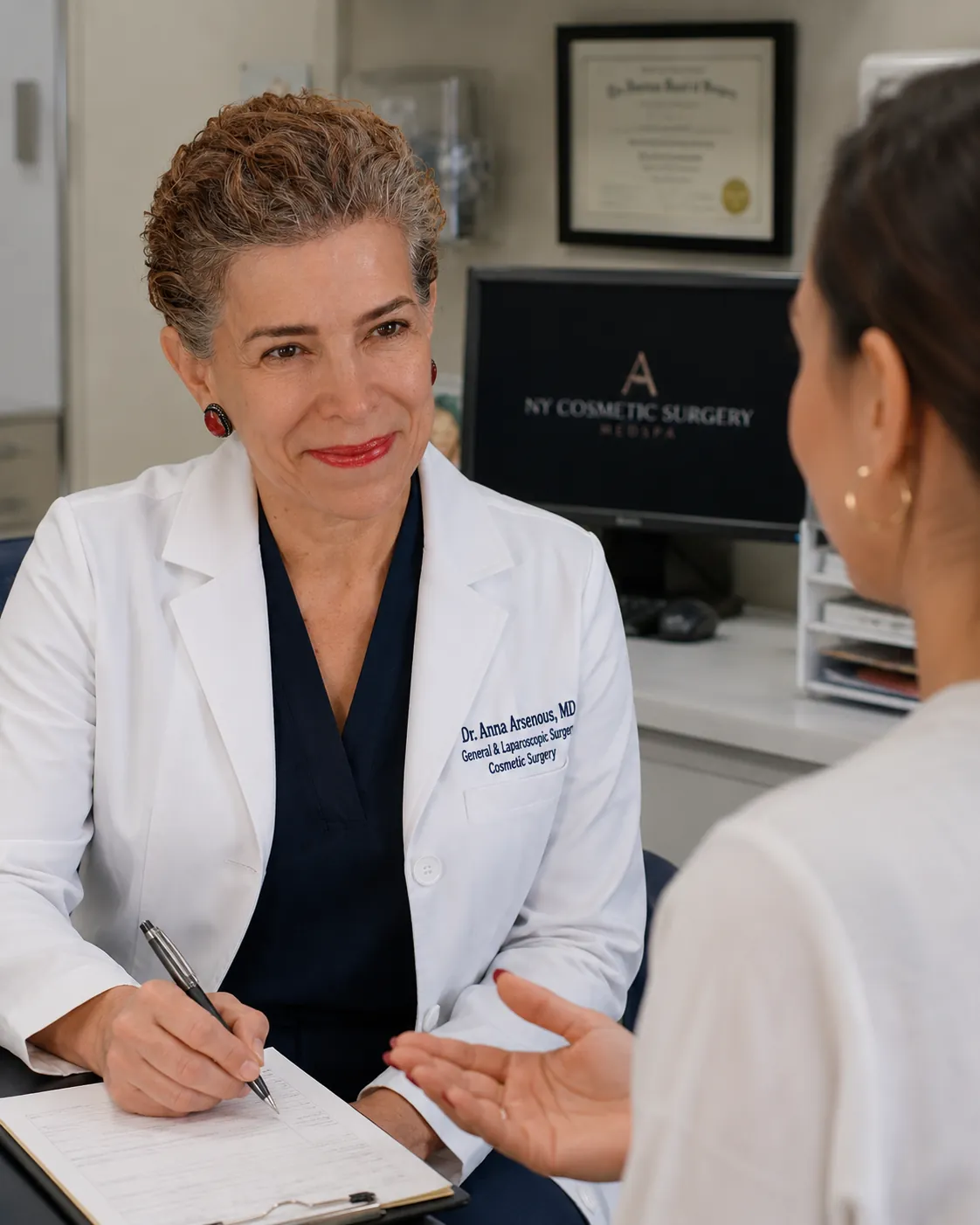
Consultations take place with Dr. Anna Arsenous, M.D., at the practice in Glendale, Queens. She is board-certified by the American Board of Surgery and has over 25 years of experience.
Who may be a candidate
How a consultation works
Your history and symptoms
Dr. Arsenous asks about your health, medications, symptoms, and how breast size affects daily life, and listens to your goals.
Examination
She examines the breasts, skin, and nipple position and takes measurements and, with your consent, photographs for your medical record.
Technique and scars
You discuss the incision pattern likely to suit your anatomy and where scars would be expected.
Planning ahead
You review preparation steps, such as pausing certain medications, arranging time off, and having someone to take you home. You can take time to decide.
What to expect, step by step.
Consultation
A detailed visit to review your symptoms, health, and goals.
Surgical planning
Technique, incision pattern, and expected scars discussed and agreed in advance.
The procedure
Performed under anesthesia at an accredited hospital (Wyckoff Heights Hospital or Northwell Forest Hills); tissue and skin are removed and the breast is reshaped.
Follow-up care
Scheduled visits to check healing, incisions, and comfort.
Recovery & results
Recovery varies. For the first several days, soreness, swelling, and bruising are common, and a surgical or support bra is worn as directed. Small drains are sometimes used and are removed at a follow-up visit.
Many patients return to desk work in about one to two weeks. Lifting, strenuous exercise, and activities that strain the chest are usually limited for several weeks. Swelling decreases gradually, and breast shape continues to settle over several months.
Scars are permanent, although they often fade and flatten over a year or more. Dr. Arsenous will go over scar care, the follow-up schedule, and when to resume routine breast cancer screening.
Risks & limitations
Every surgery carries risk. The list below is general information, not medical advice; Dr. Arsenous will review the risks that apply to your health and history at your consultation.
- Bleeding, including a collection of blood (hematoma) that may need to be drained.
- Infection or delayed healing of the incisions, particularly where incision lines meet.
- Scarring, which is permanent and may widen, thicken, or become raised in some people.
- Changes in nipple or breast sensation, which may be temporary or permanent.
- Asymmetry in breast size, shape, or nipple position.
- Possible effects on the ability to breastfeed in the future.
- Rarely, partial or complete loss of the nipple and areola because of reduced blood supply.
- Possible need for revision surgery to adjust shape, size, or scars.
Results vary; a consultation is needed to determine whether a procedure is appropriate.
Pricing & financing
Your quote depends on the treatment plan Dr. Arsenous recommends and is provided at your consultation. Financing is available through CareCredit and Affirm, subject to credit approval.


Careful planning and genuine care.
Dr. Anna Arsenous, M.D. is board-certified by the American Board of Surgery and has over 25 years of experience. She meets with each patient to review their health, explain options and risks in plain language, and answer questions before any decision is made.
Meet Dr. Arsenous →Please keep personal medical details out of texts and DMs.
Frequently asked questions.
Candidacy depends on your symptoms, health, and goals, and can only be determined after an in-person examination. A consultation with Dr. Arsenous is the place to start.
Yes. Breast reduction leaves permanent scars, often around the areola and down the lower part of the breast, and sometimes along the breast crease. Scars usually fade over time, and their likely location is discussed at your consultation.
Some people can and some cannot, because surgery can affect milk ducts and nerves. If future breastfeeding matters to you, share this at your consultation.
Many patients return to desk work in about one to two weeks and resume more strenuous activity over several weeks, following their aftercare instructions. Healing differs from person to person.
Yes. A reduction removes breast tissue to make the breasts smaller and also raises them as part of the procedure. If you mainly want a higher position without a smaller size, a breast lift may be discussed instead.
Call (212) 347-4763 or text 718-821-1000. Consultations are with Dr. Arsenous and carry a consultation fee, which our team will confirm when you book.
Related treatments
Further reading
Your questions are welcome.
Call or text us and speak with our team directly. No pressure, ever.